
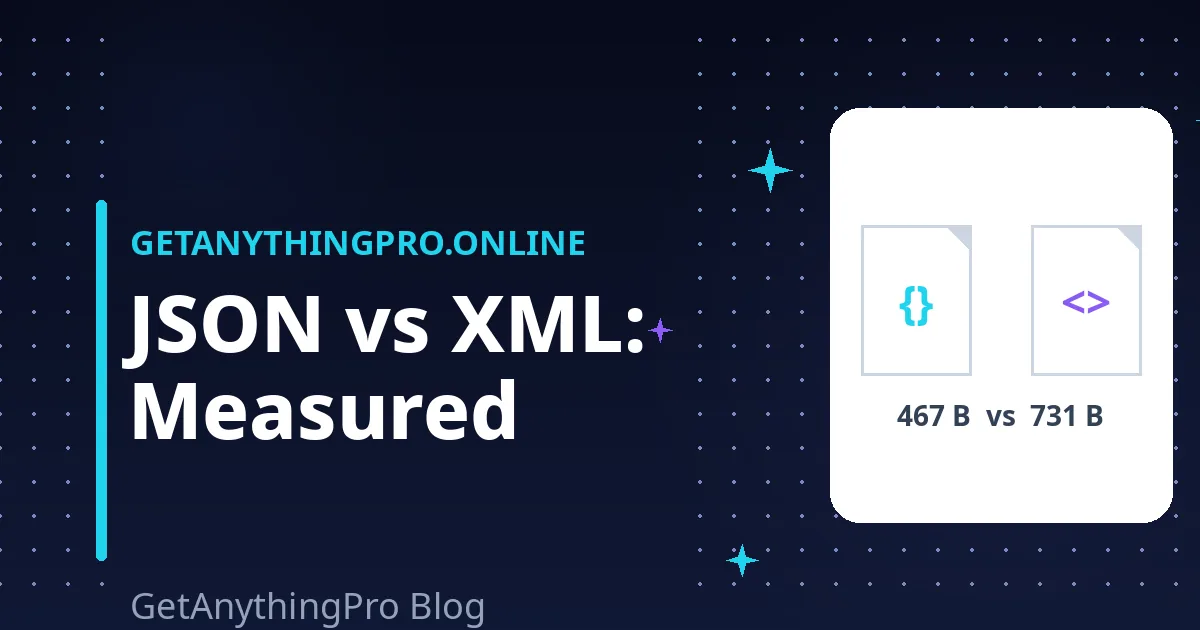
“JSON vs XML — which is better?” is one of the most asked and least useful questions in web development. The honest answer is: it depends on what you are doing, and anyone giving you a one-word answer is selling something. So instead of another recycled pros-and-cons table, this article does something the ranking pages do not: it takes one real API payload, writes it in both formats, and measures the actual byte sizes. No claims, just numbers.
Here is the short version of the JSON vs XML story: JSON (JavaScript Object Notation) won the web-API war because it is smaller, simpler, and maps directly onto the data structures programmers use. XML (eXtensible Markup Language) is older, more verbose, and more powerful — and it quietly still runs huge parts of the world’s infrastructure. If you work with APIs, config files, or documents, you need to understand both. Our free JSON Formatter will validate and pretty-print any JSON you meet along the way.
Table of Contents
- The Measured Comparison: One Payload, Real Byte Sizes
- The Real JSON vs XML Difference (Beyond Size)
- When JSON Wins
- Where XML Still Genuinely Wins in 2026
- The Decision Rule: Stop Asking Which Is Better
- Try It: JSON Formatter
- Frequently Asked Questions
The Measured Comparison: One Payload, Real Byte Sizes
Every JSON vs XML article claims JSON is “much smaller” — usually citing a vague “30–60% smaller” figure nobody sources. So I built a realistic product API response (id, name, price, tags array, nested dimensions, two variants, shipping info, timestamp) and serialized the identical data both ways. Here are the real numbers, measured in UTF-8 bytes:
- JSON, compact (no whitespace): 467 bytes
- JSON, pretty-printed (2-space indent): 680 bytes
- XML, minimal (no whitespace): 731 bytes
- XML, pretty-printed: 920 bytes
So on this representative payload: minimal XML is 56.5% larger than compact JSON (731 vs 467 bytes), and pretty XML is 35.3% larger than pretty JSON (920 vs 680 bytes). The gap narrows with pretty-printing because indentation whitespace — identical in purpose in both formats — dilutes the difference. Either way, the “XML is roughly one-and-a-half times the size” rule of thumb holds up on real data, not just in theory.
Why does this matter? On a single response, 264 bytes is nothing. Across a mobile API serving millions of requests, or a feed polled every few seconds, it compounds into real bandwidth and real battery. That compounding — not aesthetics — is the economic reason JSON displaced XML in web APIs over the 2010s.
For reference, here is what the two serializations actually look like. The JSON:
{"id":"prod-9f2a41bc","name":"Wireless Noise-Cancelling Headphones","price":249.99,"currency":"USD","in_stock":true,"rating":4.6,"tags":["audio","bluetooth","headphones","travel"],"dimensions":{"width_cm":19.5,"height_cm":25.4,"depth_cm":8.2,"weight_g":254},"variants":[{"sku":"HP-BLK-01","color":"Black","stock":34},{"sku":"HP-SLV-02","color":"Silver","stock":12}],"shipping":{"free":true,"regions":["US","CA","EU"],"eta_days":3},"updated_at":"2026-09-26T12:00:00Z"}
And the same data as minimal XML:
<product><id>prod-9f2a41bc</id><name>Wireless Noise-Cancelling Headphones</name><price>249.99</price><currency>USD</currency><in_stock>true</in_stock><rating>4.6</rating><tags><item>audio</item><item>bluetooth</item><item>headphones</item><item>travel</item></tags><dimensions><width_cm>19.5</width_cm><height_cm>25.4</height_cm><depth_cm>8.2</depth_cm><weight_g>254</weight_g></dimensions><variants><item><sku>HP-BLK-01</sku><color>Black</color><stock>34</stock></item><item><sku>HP-SLV-02</sku><color>Silver</color><stock>12</stock></item></variants><shipping><free>true</free><regions><item>US</item><item>CA</item><item>EU</item></regions><eta_days>3</eta_days></shipping><updated_at>2026-09-26T12:00:00Z</updated_at></product>
Notice where XML’s bytes go: every value pays for its tag name twice (open and close). <price>249.99</price> is 21 bytes to say what JSON says in 15 ("price":249.99). Arrays are the worst case — XML has no native array, so each item needs a wrapper tag. That structural tax is the entire size story.
The Real JSON vs XML Difference (Beyond Size)
Size is the headline, but the deeper JSON vs XML difference is philosophical. JSON models data: objects, arrays, strings, numbers, booleans, null. That is it — six types, no comments, no metadata. It maps one-to-one onto the data structures of virtually every programming language, which is why parsing JSON in Python, JavaScript, or Go is a one-liner.
XML models documents: elements, attributes, text content, comments, namespaces, processing instructions. An XML element can hold both attributes and text (<price currency="USD">249.99</price>), mix text with child elements, and be validated against a schema (XSD) with far more rigor than JSON Schema typically gets. XML namespaces let you mix vocabularies in one document without tag collisions — something JSON simply cannot do.
This is why “JSON vs XML” as a cage match misses the point. They were designed for different jobs: JSON for shipping data structures between programs, XML for representing structured documents. The web-API world converged on JSON because most APIs ship data structures. The document world kept XML because documents need what JSON lacks.
When JSON Wins
Choose JSON when:
- Building or consuming web APIs. REST APIs, webhooks, and config files are JSON’s home turf. Every HTTP client parses it natively.
- Working in JavaScript. JSON is literally JavaScript object syntax (with quoted keys);
JSON.parse()is built into the language. - Bandwidth or latency matters. The measured ~35–57% size advantage compounds at scale, and smaller payloads parse faster.
- Humans write the data. Config files, test fixtures, and mock responses are far more writable — and less error-prone — in JSON than in angle-bracket soup.
- You need arrays. JSON’s first-class arrays (
["US","CA","EU"]) beat XML’s wrapper-tag workaround every time.
Honest caveats even here: JSON has no comments (a genuine annoyance in config files — which is why JSON5, YAML, and TOML exist), no date type (dates are just strings, and every API invents its own format), and duplicate keys are technically allowed but behavior is parser-dependent. JSON is the pragmatic default, not a perfect format.
Where XML Still Genuinely Wins in 2026
Declaring XML dead is fashionable and wrong. It still runs critical infrastructure:
- SVG. Every scalable vector graphic on the web is XML. Open one in a text editor — it is elements and attributes all the way down.
- RSS and Atom feeds. Podcast distribution still runs on RSS 2.0 (XML). Your favorite podcast app parses XML daily.
- Office documents. DOCX, XLSX, and PPTX are ZIP files full of XML. When our JSON to CSV converter handles spreadsheet exports, the source format underneath is XML.
- Android layouts. Android UI layouts are XML files; the platform’s tooling is built around them.
- Enterprise and government messaging. SOAP services, SAML single sign-on, HL7 healthcare data, and financial messaging (ISO 20022) are XML ecosystems with schemas, namespaces, and digital signatures (XML-DSig) — machinery JSON never developed equivalently.
- Mixed content. A document like “click here for details” — text interleaved with markup — is natural in XML and awkward in JSON.
If your problem involves documents, namespaces, mixed content, or an industry standard written in XML, reaching for JSON because it is trendier is a mistake. Use the format the ecosystem speaks.
The Decision Rule: Stop Asking Which Is Better
Here is the practical rule that replaces the whole JSON vs XML debate:
- Default to JSON for APIs, configs, and data exchange between programs — smaller, simpler, universally supported.
- Use XML when you need documents with mixed content, namespaces, schema validation with teeth, or digital signatures — or when the system you are integrating with already speaks XML.
- Never convert for fashion. If a working system exchanges XML reliably, “modernizing” it to JSON buys you little and risks subtle breakage (attribute-vs-element distinctions, namespace handling, and whitespace semantics do not round-trip cleanly).
- Measure before optimizing. If payload size is your actual concern, compress first: gzip typically shrinks both formats by 70–80%, dwarfing the JSON-vs-XML gap. The measured 264-byte difference on our sample becomes ~50 bytes after compression.
That last point deserves emphasis because it reframes the entire debate: after gzip, the JSON vs XML size argument mostly evaporates. Choose on semantics and ecosystem, not bytes.
Try It: JSON Formatter
Whichever side of the JSON vs XML divide you land on, malformed JSON is the more common daily pain — a missing comma or an unquoted key breaks the whole parse. Our free JSON Formatter validates, pretty-prints, and minifies JSON in your browser, and our JSON to CSV converter handles the flattened-export case. For the authoritative definitions, see json.org and the W3C’s XML pages — primary sources beat blog summaries, including this one.
Frequently Asked Questions
What is the main difference between JSON and XML?
JSON is a lightweight data-interchange format with six types (objects, arrays, strings, numbers, booleans, null) that maps directly onto programming data structures. XML is a document markup language with elements, attributes, namespaces, and comments, designed for structured documents. Measured on the same payload, XML runs about 35-57% larger than JSON.
Is JSON faster than XML?
Generally yes for parsing: JSON’s simpler grammar means parsers do less work, and the smaller payloads transfer faster. But the difference is usually dwarfed by network latency, and gzip compression shrinks the size gap dramatically. Choose on semantics and ecosystem fit, not micro-benchmarks.
When should you use XML instead of JSON?
Use XML for documents with mixed content (text interleaved with markup), when you need namespaces to combine vocabularies, when an industry standard (SOAP, SAML, HL7, RSS, DOCX, SVG, Android layouts) mandates it, or when you need XML digital signatures. For plain data exchange between programs, JSON is the better default.
Why is JSON preferred over XML for APIs?
Three reasons: it is smaller (measured ~35-57% on typical payloads), it maps one-to-one onto the objects and arrays programmers actually use so parsing is a one-liner, and it is far more writable by hand. The web-API ecosystem standardized on JSON during the 2010s, so tooling and documentation assume it.